


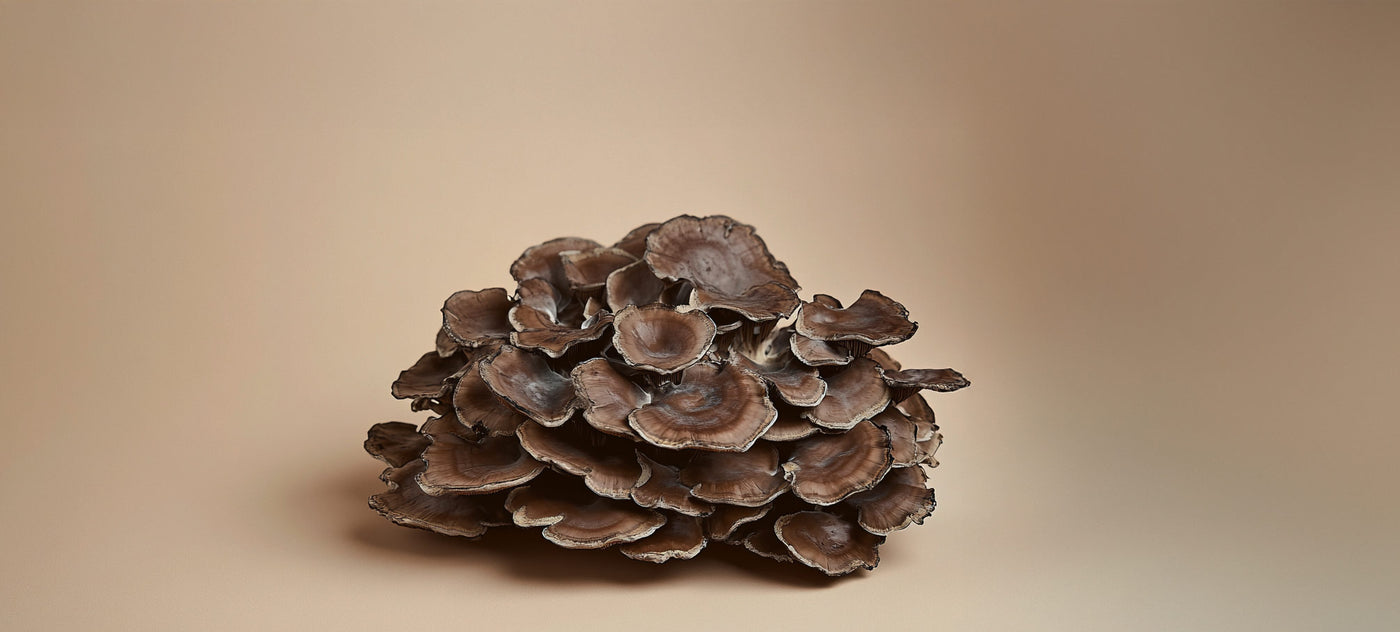

ESSENTIAL NOTES ON THE “DANCING MUSHROOM”
Actually, the G. Frondosa contains beta-glucanos whose structure is more complex than those present in cereals such as oatmeal. However, this structure is directly related to its action. It also contains provitamin D, ergotinein and gaba. In summary, its nutritional profile is very interesting, as well as its bioactive molecules.

DOCUMENTED USES OF MAITAKE
Maitake, alongside Reishi and Shiitake, is widely recognised for its rich natural profile. While fresh Maitake is enjoyed as a culinary mushroom, concentrated food supplement extracts offer a standardised way to complement your daily routine. (Food supplements should not be used as a substitute for a varied and balanced diet and a healthy lifestyle.)
Concentrated Naturally Occurring Compounds
Additionally, whole fungal biomass can be processed via low-temperature dehydration and fine milling to yield what is commonly termed micronised powder.
Products with Maitake
-

 Hasta - 10 %
HIFAS-Detox (Maitake and Polyporus extract) capsules
WITH POLYPORUS & MAITAKE
From 42,50 €Unit price /Unavailable -


Mico Mix (Shiitake, Reishi, Maitake) Capsules
REISHI, MAITAKE & SHIITAKE
60,00 €Unit price /Unavailable -

 TOP SELLERSHasta - 10 %
Mico Five (Chaga, Reishi, Maitake, Shiitake, Sun mushroom) Capsules
FIVE-MUSHROOM BLEND + VITAMIN C
From 50,00 €Unit price /Unavailable


Maitake cultivation
Maitake is a parasitic and saprotrophic fungus that primarily colonises the base and roots of mature or decaying oak trees. Outdoor log cultivation can be challenging; therefore, controlled cultivation is typically carried out by inoculating hardwood log sections or stumps with specialised fungal spawn, which are then partially buried to maintain essential humidity levels.
Cultivation Protocols and Substrates
In modern commercial production, indoor cultivation utilizing aerated grow bags filled with sterilized sawdust and organic bran or rice flour substrates is widely favored for higher yield and consistency. While hardwood substrates remain the gold standard, occasional occurrences on conifer stumps have been documented—a phenomenon noted in mycological research by Paul Stamets.
As one of East Asia's most popular edible and functional mushrooms—particularly in Japan—Maitake cultivation techniques were refined and standardized during the 1970s, establishing the foundation for modern indoor biotech cultivation.
Featured Biomolecules
This species contains substances, including:


Do you want to know more?
Habitat and distribution
Habitat and distribution
This mushroom grows worldwide in deciduous forests in temperate climates. It is mainly found on the stumps of old oak trees, but also on chestnut, beech and lime trees. In the same way, the G.Frondosa, presents a wide distribution in the temperate areas of the northern hemisphere, passing from Europe to northern North America, Japan and China. In the early stages of its development, this species is soft and suitable for its kitchen; On the other hand, as it grows, it acquires a woody consistency, which hinders its consumption as food. Given these circumstances, it is usually consumed through Food accessories.
Mycological notes
Mycological notes
G. Frondosa and G. Umbellata. Actually, the Japanese name Maitake And it is composed of a set of small mushrooms with each other that they give it Floral set aspect well ordered on an axis. Of this, their overlapping hats, which form a fan -shaped mosaic as in traditional Japanese dances. Finally, we cannot forget that this mushroom is typical of autumn, appearing with the arrival of the first rains on touches of cut trees. The fruiting body of the mushroom is large size, being able to reach 20 kg of weight and 60 cm high.
The culture in bioreactors
The culture in bioreactors
Quality, Purity, and Consistency in Our Production Systems
Our commitment to excellence is reflected in our strict quality assurance standards, ensuring purity and consistent quality across our products.
R&D and Maitake Studies
R&D and Maitake Studies
- Hifas da Terra conducts studies to improve fungus production processes and optimize the development of new biotechnological base ingredients
- Hifas da Terra has, in its wide mycoteca (Micological Bank Hifas), its own strains isolated from the Iberian Peninsula that selects for the development of its formulas
- Hifas da Terra develops multiple studies in collaboration with research centers and universities.
Curiosities
Curiosities
- Some taxonomists believe that the name Grifola derives from Grifone, a mythological animal with the head and wings of an eagle, but with the legs and tail of a lion. Frondosa means “leaf-shaped”, as the fruiting body looks like overlapping leaves. In Japan, it is known as the “dancing mushroom” because, in the past, anyone who found one would dance with joy at the thought of the profit they would make from their discovery. According to Japanese texts, samurai were the main buyers of this species because of its qualities.